When the response worked
- The setting and relevant cue.
- The observable behavior.
- How the action affected the activity you were trying to do.
An anxiety-related PSD assessment considers the person’s functional needs and the dog’s learned assistance. Describe a real response, when it occurs and where it remains uncertain, then discuss the clinical documentation question.
For this conversation, the helpful starting point is a sequence you have observed. A description of the dog’s temperament cannot fill in the missing details of a trained response.
Identify the activity or situation affected by anxiety without assuming that everyone with the same diagnosis has the same limitation.
Name the behavior, the cue if used, and the training behind the response. Separate deliberate learning from a spontaneous approach.
Explain the practical connection between the learned behavior and your limitation, including any uncertainty about its effect.
The ADA’s service-animal guidance explains why these descriptions have different implications. If your question is housing companionship, start with anxiety and ESA documentation.
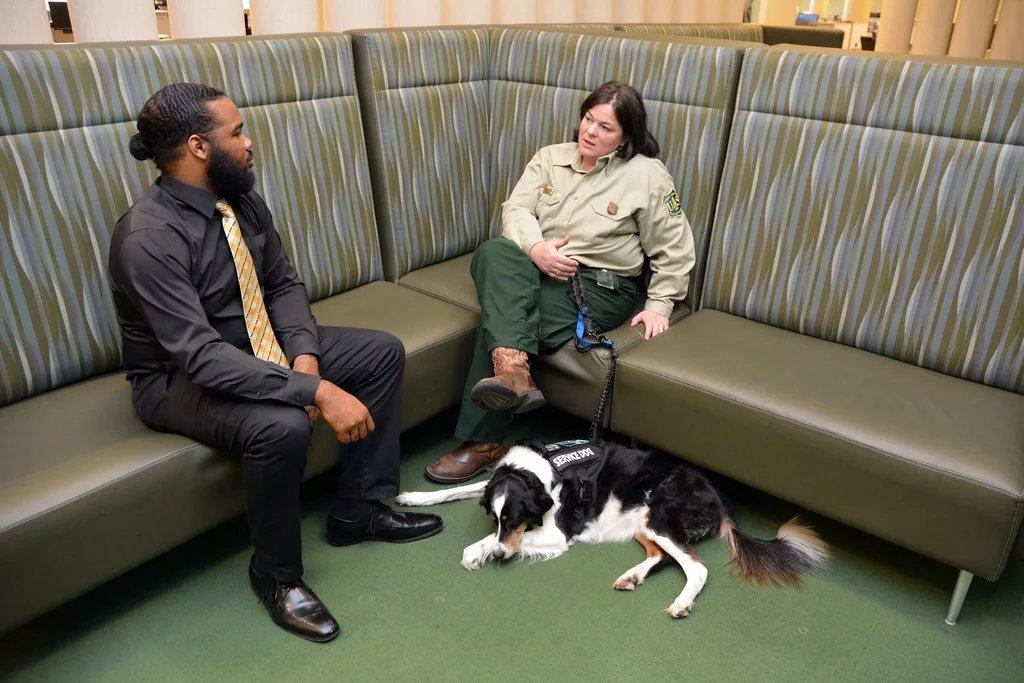
The photograph illustrates a handler and dog; it is not evidence of anxiety-related training or a claim about the pictured people.Bring a successful response and an occasion that was incomplete or uncertain. You do not need to provoke distress to create evidence.
Tell the trainer where the learned response is dependable and where distractions make it harder. A quiet practice session is only one part of the picture.
Describe stress, avoidance, or difficulty settling without treating those signs as proof of assistance. Ask for an assessment of the dog’s suitability and welfare.
Discuss support for occasions when the animal is absent, ill, or unable to work. Keep clinical care decisions with the appropriate health professional.
Bring the individual anxiety-related limitation to the clinician responsible for the assessment.
Take observations about task consistency and unfinished skills to an appropriate trainer.
Identify the location and purpose of the visit, then check the rule that governs that setting.
Compare the clinical-documentation service with your actual question. The catalog does not include teaching anxiety-related tasks, testing a dog’s performance, or guaranteeing a preferred clinical conclusion.
$149.00
24-48 Hour
$159.00
24-48 Hour
$199.00
24-48 Hour
$199.00
24-48 Hour
$225.00
24-48 Hour
Colorado Service Animals does not offer an ESA registry. A professional evaluation determines whether documentation is appropriate; optional cards and certificates do not establish access rights.
Use the customer account for clinical follow-up and ask which records are needed. A brief task observation and a detailed anxiety history serve different purposes, even when both inform the conversation.
Return to the existing case“I can describe what the dog has learned, but I need help deciding which part of my clinical history is relevant to this request.”
A question you can adapt for your own assessment
Free screening starts with your circumstances. Keep the account candid, including responses that are still being learned or do not reliably occur.
Provide your own answers and identify the dog's learned action in the PSD request.
A Colorado-licensed professional considers the anxiety-related functional effects and whether documentation is clinically supported.
Approved letters arrive by email. Report an error to the issuer; the document does not add a new skill to the dog.
Ask for the professional name, credential type and number used for the assessment.
Use Colorado's credential verification tool to find the matching professional. Resolve an unclear record with the service before treating a company badge as proof.
No. Comfort from presence is different from an individually trained action related to a disability. The distinction depends on what the dog has actually been trained to do.
Ask the clinician and trainer whether an already trained interruption or response is relevant to your specific difficulty. A dog approaching for affection is not, by itself, evidence of a trained task.
Only use an alert description when it reflects established training and observed behavior. An affectionate approach may be comforting without being a trained disability-related response.
No. A certificate cannot establish the behavior. Reliability depends on the dog’s actual training and performance, and public-access responsibilities remain separate.
No. Use observations you already have. Do not create a distressing situation for an application; discuss uncertainty about the response with the appropriate clinician or trainer.
You can ask about the clinical question, but describe unfinished training honestly. A clinical letter cannot establish a task the dog has not learned or make an unready dog suitable for a public setting.
Anxiety-related PSD preparation for Colorado applicants, reviewed October 2026; not medical advice or legal advice. Local authority rules may change, so verify the applicable setting. Screening does not guarantee documentation or establish a dog’s skills. CSA is unaffiliated with licensing agencies and property associations. Crisis counseling can be reached through 988 .
An anxiety-related service-dog inquiry starts with more than comfort: explain the learned response and the limitation it addresses. Use the assessment to clarify clinical documentation questions while maintaining appropriate care.