Skip to content
Colorado · ADHD · Cues and learned responses

PSD Letters for ADHD in Colorado

Prepare a Colorado PSD letter request for ADHD with a specific account of the cue, the dog’s learned action and its functional purpose. Explain how that work differs from an alarm, a household routine or an unfinished training goal.

Observable cues
Actual learned work
Accurate task records

Follow the cue, the dog’s action, and the functional purpose

What starts it?
Identify the signal or circumstance associated with a learned response.
What does the dog do?
Describe an observable action, not an assumed understanding of ADHD.
Why is it assistance?
Explain its connection to the individual’s disability-related limitation.

This sequence helps make the request understandable. A well-described goal is still only a goal if the dog has not learned the behavior.

Distinguish the dog’s learned contribution from other reminders

A phone alarm, a written schedule, and the routine of feeding an animal may each be useful. They do not establish that the dog performs an individually trained action.

Describe the actual division of work

If the alarm gives the reminder and the dog has no taught response, say so. If the animal performs a separate learned action, explain that behavior without attributing the whole system to it.
Read about ADHD-related companionship in housing
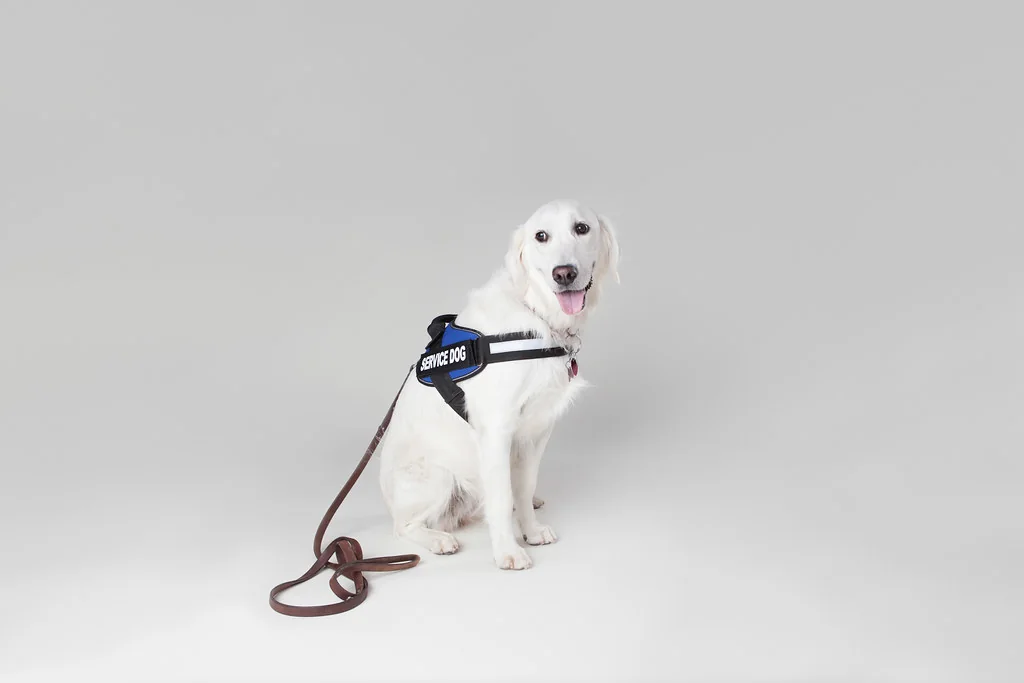
Light-colored dog wearing a harness and sitting beside its leash
Found Animals, CC BY-SA 2.0
Photo detailsGolden Retriever Service Dog 2. Resized and converted to WebP; displayed with responsive cropping.

Use a brief task record instead of a sweeping claim

Bring a small set of accurate observations. Include incomplete responses so the training stage is visible.

Prompts for your own notes, not completed case evidence
Cue and setting

What prompted the response, and where did it occur?

Keep a familiar practice setting distinct from an unfamiliar environment.
Action performed

What could another observer see the dog doing?

Avoid describing intentions you cannot observe.
Result and limitation

What practical help followed, and what did not happen?

Record missed cues or a response that still needs work.
From notes to clinical review

Submit the ADHD assistance question with the cue and response identified

Free screening introduces your circumstances to the documentation process. Use a short, accurate record of the learned action; an elaborate description cannot establish training that has not occurred.

Record the screening details
Explain the functional concern and what the dog actually does. Note incomplete skills as unfinished rather than selecting a more impressive label.
Discuss the evidence with a clinician
A professional licensed in Colorado evaluates the documentation need and requests clarification when the account is incomplete.
Check the approved letter after email delivery
If the clinical review supports documentation, the letter arrives electronically. Keep questions about its findings with the clinician.
Free Screening
  • Observable work
  • Individual clinical finding
  • Email after approval

Keep professional questions focused on their purpose

Ask the clinician about the individual need

Describe how ADHD-related difficulties affect your functioning and what documentation is being requested.

NIMH’s ADHD information

Ask the trainer about the learned behavior

Discuss cue-response reliability, dog welfare, handling, and the steps needed for an unfinished skill.

Prepare for a training discussion

Verify who will assess the Colorado documentation request

Keep the professional's identity with your appointment notes, especially when a service name and an individual clinician's name differ.

Match the professional record
Search the clinician's name and license through Colorado's credential lookup . Check the license type and status before deciding that a similarly named record belongs to your evaluator.
Resolve an unclear match
Ask the service for the exact professional name and credential number. A clear license record identifies the practitioner; it does not promise the outcome of an ADHD-related request.
Yellow dog in a red harness lying on a carpet
Eden Aviv, CC0
Photo detailsService dog laying down.jpg. Resized and converted to WebP; displayed with responsive cropping.

ADHD task records and documentation questions

Large homes and leafless trees in Denver’s Humboldt Street Historic District
Ken Lund, CC BY-SA 2.0
Photo detailsHumboldt Street Historic District, Denver, Colorado. Resized and converted to WebP; displayed with responsive cropping.
  1. Is the structure of caring for a dog enough to make it a PSD?

    Not on its own. A psychiatric service dog performs individually trained work related to a disability; general structure from pet ownership is a different benefit.

  2. Can I list a planned reminder task as already trained?

    No. Identify it as a training goal. Documentation should distinguish a future cue-response plan from a behavior the dog currently performs reliably.

  3. Does a PSD package include ADHD dog training?

    The listed service concerns clinical review and documentation. Do not assume the purchase includes a trainer, a trained dog, or proof of task reliability.

  4. How can I describe trained assistance related to ADHD?

    A trained cue or retrieval must be described as an action the dog actually performs. An ordinary alarm, a household routine, or a dog asking for food is not automatically a disability-related task.

  5. What if a phone alarm is part of the same routine as the dog's response?

    Describe each part of the sequence. Explain what the device does and whether the dog performs a distinct learned action, so the evaluator can understand the animal's actual contribution.

  6. Do I need a perfect training log before asking about documentation?

    Use accurate observations you already have and state what you cannot verify. The reviewer may ask for clarification; do not invent dates, successful responses or professional training records to fill gaps.

Answer a follow-up with the behavior rather than the package name

If the reviewer asks what the dog does, the useful answer is the taught action and its purpose. An ID card, a vest, or a selected plan does not supply that explanation.

If the response is unfinished
Label it as a training objective and describe what has been achieved so far.
If the response is inconsistent
Explain the settings or cues where it breaks down, rather than reporting only the best attempt.
If your routine has changed
Update the account of practice and care responsibilities so it reflects the current arrangement.

Simple, Transparent Pricing for Colorado ADHD Documentation

Choose the service after clarifying what is to be evaluated. Optional identification products do not verify the cue-response sequence, and the purchase does not provide a dog or ongoing training.

ESA Housing Letter For One Pet

$149.00

24-48 Hour

  • ESA Documentation
  • Licensed Professional Review
  • 24-48 Hour Processing
  • Valid for 1 Year
  • Digital Copy
  • Renewal Reminders
  • Email Support
Get Started

PSA Letter

$199.00

24-48 Hour

  • PSD Documentation
  • Licensed Professional Review
  • 24-48 Hour Processing
  • Valid for 1 Year
  • Digital Copy
  • Renewal Reminders
  • Priority Phone & Email Support
Get Started

Bundle Packages

Bundle

ESA Letter + Certificate Bundle

$199.00

24-48 Hour

  • ESA Documentation
  • ESA Certificate
  • Licensed Professional Review
  • 24-48 Hour Processing
  • Digital Copies
  • Priority Phone & Email Support
Get This Bundle
Bundle

PSD Letter + Certificate + ID Card

$225.00

24-48 Hour

  • PSD Documentation
  • PSD Certificate
  • PSD ID Card
  • Licensed Professional Review
  • 24-48 Hour Processing
  • Digital Copies Only
  • Priority Phone & Email Support
Get This Bundle
Clinical assessment Secure checkout Current catalog prices

Colorado Service Animals does not offer an ESA registry. A professional evaluation determines whether documentation is appropriate; optional cards and certificates do not establish access rights.

Continue with evidence about the person and the dog

Sources and review date: October 12, 2026

ADHD task-record guidance for Colorado residents, reviewed October 2026. The content is not medical advice or legal advice. Verify current local authority rules, which may change. An organized record and free screening do not guarantee documentation or establish trained work. CSA has no affiliation with government offices or property associations. If attention-related difficulties occur alongside urgent emotional distress, crisis assistance is available at 988 .

Bring an observable ADHD task into the discussion

Explain what the dog has learned, what prompts the action, and how it assists with your limitation. Record uncertainty honestly instead of presenting a training goal as a completed skill.

Current routines
Honest limits
Defined contributions